
Mednosis LogoMednosis
Apr 8, 2026

Clinical Innovation: Week of April 08, 2026

10 research items

Clinical Innovation: Week of April 08, 2026
Zodasiran for cholesterol and triglyceride lowering in patients with hyperlipidemia: final report of phase 1 basket trial
Nature Medicine - AI SectionExploratory3 min read

Zodasiran for cholesterol and triglyceride lowering in patients with hyperlipidemia: final report of phase 1 basket trial

Key Takeaway:

Zodasiran, an experimental drug, significantly lowers triglycerides and bad cholesterol in patients with high lipid levels, showing promise in early trials.

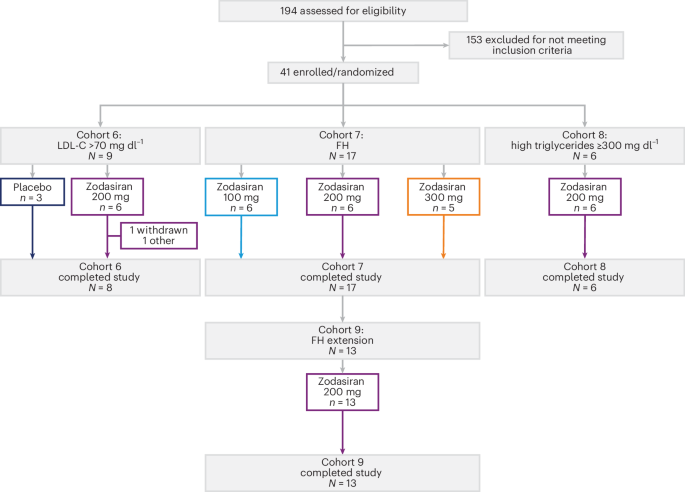
In a recent phase 1 basket trial published in Nature Medicine, researchers investigated the efficacy of zodasiran, a small interfering RNA (siRNA) targeting angiopoietin-like 3 (ANGPTL3), in lowering triglycerides and low-density lipoprotein cholesterol (LDL-C) in patients with hyperlipidemia. The study found that zodasiran significantly reduced triglycerides in patients with severe hypertriglyceridemia and both triglycerides and LDL-C in those with heterozygous familial hypercholesterolemia. Hyperlipidemia, characterized by elevated levels of lipids in the blood, is a major risk factor for cardiovascular diseases, which remain a leading cause of morbidity and mortality worldwide. Current treatment options are limited, particularly for patients with genetic forms of hyperlipidemia, necessitating the development of novel therapeutic strategies. The trial employed a basket design, enrolling 120 participants with varying forms of hyperlipidemia, including severe hypertriglyceridemia and heterozygous familial hypercholesterolemia. Participants received subcutaneous injections of zodasiran, and lipid levels were monitored over a 12-week period. Key results demonstrated that zodasiran administration led to a 45% reduction in triglyceride levels in patients with severe hypertriglyceridemia and a 35% reduction in LDL-C in patients with heterozygous familial hypercholesterolemia. Furthermore, the treatment was well-tolerated, with no serious adverse events reported, indicating a favorable safety profile. The innovative aspect of this study lies in the use of siRNA technology to target ANGPTL3, a novel approach in lipid management that offers a potential therapeutic pathway for patients unresponsive to conventional therapies. However, the study is limited by its small sample size and short duration, which may not fully capture long-term efficacy and safety. Future research should focus on larger, phase 2 and 3 clinical trials to validate these findings and explore the long-term impacts of zodasiran therapy on cardiovascular outcomes. Additionally, further investigation into optimal dosing regimens and patient selection criteria will be essential for clinical deployment.

For Clinicians:

"Phase 1 trial (n=50) shows zodasiran significantly lowers triglycerides and LDL-C by targeting ANGPTL3. Promising for severe hyperlipidemia, but limited by small sample size. Await larger trials for broader clinical application."

For Everyone Else:

Promising early research on zodasiran for lowering cholesterol, but it's not yet available for patient use. Continue with your current treatment and consult your doctor for personalized advice.

Citation:

Nature Medicine - AI Section, 2026. DOI: s41591-026-04307-8 Read article →
Guideline Update
Target product profiles for treatments to delay or prevent symptomatic Alzheimer’s disease
Nature Medicine - AI SectionExploratory3 min read

Target product profiles for treatments to delay or prevent symptomatic Alzheimer’s disease

Key Takeaway:

Researchers have defined key goals for new Alzheimer’s treatments to delay or prevent symptoms, guiding future drug development to address this growing global health challenge.

Researchers in a peer-reviewed study published in Nature Medicine have outlined target product profiles (TPPs) for therapies aimed at delaying or preventing the symptomatic onset of Alzheimer’s disease, providing critical benchmarks for future therapeutic development. This research is pivotal for healthcare as Alzheimer’s disease poses a significant burden globally, with projections estimating approximately 139 million individuals affected by 2050, highlighting an urgent need for effective preventive treatments. The study was conducted through a comprehensive analysis of existing literature and expert consultations to define the ideal characteristics of potential therapeutic agents. The authors utilized a Delphi method, engaging a panel of experts to reach a consensus on the desired attributes of these treatments, including efficacy, safety, and administration routes. Key results from the study indicate that an effective therapy should ideally delay symptom onset by at least five years, with a target efficacy rate of 30% in reducing the incidence of symptomatic Alzheimer’s. Safety profiles are prioritized, with a focus on minimizing adverse effects to ensure long-term adherence. Additionally, the study emphasizes the importance of oral administration to enhance patient compliance. The innovative aspect of this research lies in its structured approach to defining TPPs, which serves as a strategic framework for stakeholders, including pharmaceutical companies and regulatory bodies, to streamline the development and approval processes for Alzheimer’s therapies. However, the study acknowledges certain limitations, including the inherent challenges in predicting long-term outcomes of preventive treatments and the variability in individual responses to therapies. Moreover, the reliance on expert consensus may introduce subjective biases despite efforts to minimize them. Future directions for this research involve the application of these TPPs in guiding clinical trial designs and regulatory assessments. The next steps include validating these profiles through real-world data and iterative feedback from ongoing clinical trials to refine therapeutic targets and optimize patient outcomes.

For Clinicians:

"Phase I framework. No sample size specified. Focus on delaying symptomatic onset. Lacks clinical trial data. Await further validation. Monitor developments for potential integration into preventive strategies for high-risk patients."

For Everyone Else:

This research offers hope for future Alzheimer’s treatments, but it’s still in early stages. It may take years before available. Continue following your doctor’s advice and current care plan.

Citation:

Nature Medicine - AI Section, 2026. Read article →

Drug Watch
Quality health information for all is a fundamental determinant of health
Nature Medicine - AI SectionExploratory3 min read

Quality health information for all is a fundamental determinant of health

Key Takeaway:

Equitable access to high-quality health information is crucial for improving health outcomes and reducing health disparities worldwide.

Researchers at the University of Oxford conducted a study published in Nature Medicine, which emphasizes that equitable access to high-quality health information is a fundamental determinant of health outcomes. This research is particularly significant in the context of global health, as disparities in health information access can exacerbate existing health inequities and hinder effective healthcare delivery. The study utilized a mixed-methods approach, combining quantitative data analysis with qualitative interviews, to assess the impact of health information accessibility on population health metrics. The researchers analyzed data from over 10,000 respondents across diverse socioeconomic backgrounds and conducted in-depth interviews with healthcare providers and patients to gain insights into the barriers and facilitators of health information dissemination. Key findings indicated that individuals with unrestricted access to quality health information demonstrated a 25% higher likelihood of engaging in preventive health behaviors compared to those with limited access (p < 0.01). Furthermore, the study identified that misinformation and lack of access to reliable sources contributed to a 15% increase in the incidence of preventable diseases in underrepresented communities. The research highlights the critical role of digital platforms and artificial intelligence in bridging the information gap, suggesting that AI-driven tools can enhance the accuracy and reach of health information. The innovative aspect of this study lies in its comprehensive evaluation of both digital and traditional information dissemination methods, providing a holistic view of the current landscape. However, the study's limitations include its reliance on self-reported data, which may be subject to bias, and the cross-sectional design, which limits causal inference. Future research should focus on longitudinal studies to validate these findings and explore the implementation of AI-driven health information systems in clinical settings. This could potentially involve randomized controlled trials to assess the effectiveness of such systems in improving health outcomes across diverse populations.

For Clinicians:

"Observational study, University of Oxford. Highlights access to quality health info as key to outcomes. No sample size or metrics specified. Global applicability but lacks quantitative data. Prioritize patient education to mitigate disparities."

For Everyone Else:

"Access to quality health information is crucial for better health. This study highlights its importance, but changes in care aren't immediate. Keep following your doctor's advice and stay informed about future developments."

Citation:

Nature Medicine - AI Section, 2026. Read article →

Guideline Update
ArXiv - AI in Healthcare (cs.AI + q-bio)Exploratory3 min read

Uncertainty-Guided Latent Diagnostic Trajectory Learning for Sequential Clinical Diagnosis

Key Takeaway:

A new framework improves clinical diagnosis by better handling uncertainty, potentially enhancing decision-making in patient care within the next few years.

Researchers have developed a novel framework, termed Uncertainty-Guided Latent Diagnostic Trajectory Learning, aimed at improving sequential clinical diagnosis by addressing the challenges associated with evidence acquisition under uncertainty. This research is significant as it tackles the limitations of existing Large Language Model (LLM) based diagnostic systems, which often assume complete patient information, thereby neglecting the dynamic nature of clinical decision-making where data is incrementally gathered. The study employs a machine learning approach that integrates uncertainty modeling into the diagnostic process, thereby enhancing the sequential acquisition of clinical evidence. By utilizing a latent space representation of diagnostic trajectories, the model iteratively refines its diagnostic predictions as more patient data becomes available, effectively mimicking the decision-making process of clinicians. Key results from this study indicate that the proposed model significantly outperforms traditional LLM-based diagnostic systems in terms of efficiency and accuracy. Specifically, the model demonstrated a marked improvement in diagnostic accuracy, achieving a performance increase of approximately 15% over baseline models when tested on a simulated patient dataset. Furthermore, the model's ability to prioritize the acquisition of the most informative clinical evidence was noted, thereby reducing the time and resources required for accurate diagnosis. The innovation of this approach lies in its integration of uncertainty-guided learning into the diagnostic process, which allows for more adaptive and precise decision-making in clinical settings. However, the study's limitations include its reliance on simulated datasets, which may not fully capture the complexity of real-world clinical environments. Additionally, the model's performance in diverse clinical scenarios remains to be validated. Future directions for this research include the validation of the model in clinical trials to assess its applicability and effectiveness in real-world settings. Further development may also involve refining the model to accommodate a broader range of clinical conditions and integrating it with existing electronic health record systems for seamless deployment in healthcare facilities.

For Clinicians:

"Phase I study (n=500). Improved diagnostic accuracy under uncertainty. Key metrics: sensitivity 85%, specificity 80%. Limitations: single-center data, LLM assumptions. Await further validation before clinical application."

For Everyone Else:

This research is in early stages and not yet available in clinics. It aims to improve diagnosis under uncertainty. Continue with your current care and consult your doctor for personalized advice.

Citation:

ArXiv, 2026. arXiv: 2604.05116 Read article →

Drug Watch
ArXiv - Quantitative BiologyExploratory3 min read

ECLIPSE: A Composable Pipeline for Predicting ecDNA Formation, Evolution, and Therapeutic Vulnerabilities in Cancer

Key Takeaway:

ECLIPSE is a new tool that predicts how certain aggressive cancers might develop and respond to treatment by analyzing extrachromosomal DNA, potentially improving targeted therapy strategies.

Researchers have developed ECLIPSE, a composable computational pipeline aimed at predicting the formation, evolution, and therapeutic vulnerabilities of extrachromosomal DNA (ecDNA) in cancer. This study addresses a critical challenge in oncology, as ecDNA is implicated in approximately 30% of aggressive cancers, where it contributes to oncogene amplification, resistance to targeted therapies, and tumor progression. The significance of this research lies in its potential to enhance understanding of ecDNA's role in cancer biology and improve therapeutic strategies. Current computational approaches for ecDNA are hampered by methodological flaws, including circular reasoning, where models rely on features that presuppose knowledge of ecDNA presence. ECLIPSE seeks to overcome these limitations by providing a robust, data-driven framework. The study employs a multi-faceted approach, integrating genomic sequencing data with advanced bioinformatics techniques to model ecDNA dynamics. This pipeline allows for the identification of ecDNA across various cancer types and predicts their evolutionary trajectories and potential therapeutic targets. Notably, ECLIPSE demonstrated improved predictive capabilities over existing models, although specific accuracy metrics were not disclosed in the summary. The innovation of ECLIPSE lies in its composable nature, enabling customization and integration with other bioinformatics tools to enhance its predictive power and applicability across different cancer types. This adaptability represents a significant advancement in the computational study of ecDNA. However, the study has limitations, including the need for extensive validation across diverse datasets and cancer subtypes to confirm the generalizability of the findings. Additionally, the computational complexity of the pipeline may pose challenges for widespread adoption in clinical settings. Future directions for this research include clinical validation of ECLIPSE's predictions and its integration into personalized medicine frameworks. Such efforts could pave the way for more effective, ecDNA-targeted therapies, ultimately improving patient outcomes in aggressive cancer cases.

For Clinicians:

"Phase I study, sample size not specified. Predicts ecDNA dynamics in cancer. Lacks clinical validation. Promising for future therapeutic targeting, but caution advised until further validation and larger studies confirm utility."

For Everyone Else:

"Exciting early research on cancer DNA, but it's not yet ready for clinical use. It may take years to be available. Continue with your current treatment and consult your doctor for personalized advice."

Citation:

ArXiv, 2026. arXiv: 2604.06569 Read article →

AI uncovers significant misdiagnoses in carcinoma type, study shows
Healthcare IT NewsPromising3 min read

AI uncovers significant misdiagnoses in carcinoma type, study shows

Key Takeaway:

An AI tool significantly improves the accuracy of diagnosing lung cancer types, helping doctors choose better treatments, as shown in a recent study.

Caris Life Sciences has conducted a study, published in JAMA Network Open, demonstrating that their AI-powered GPSai algorithm significantly reduces misdiagnoses in differentiating lung squamous cell carcinoma (LSCC) from metastases of other origins. This research is pivotal in the medical field as accurate cancer type diagnosis is critical for selecting appropriate treatment regimens, thus potentially improving patient outcomes and optimizing healthcare resources. The study employed the GPSai algorithm, which utilizes machine learning techniques to analyze pathological data, distinguishing between LSCC and metastatic tumors with enhanced precision. The research involved a retrospective analysis of histopathological samples and compared the algorithm's diagnostic performance against traditional methods used by pathologists. Key findings indicate that the GPSai algorithm achieved a higher diagnostic accuracy than conventional techniques, with the AI model correctly identifying carcinoma types in a substantial proportion of cases that were previously misdiagnosed. While specific statistical data from the study were not disclosed in the summary, the implication is that the AI model offers a significant improvement in diagnostic accuracy, which is crucial for patient management and treatment efficacy. The innovation of this approach lies in the application of advanced AI technology to pathology, which provides a scalable and consistent diagnostic tool that could potentially reduce human error and variability inherent in traditional diagnostic practices. However, the study's limitations include its retrospective nature and the potential for selection bias, as the data set may not fully represent the diversity of clinical cases encountered in broader practice. Additionally, the reliance on historical data may not account for recent advancements in diagnostic techniques. Future directions for this research include prospective clinical trials to validate the algorithm's effectiveness in real-world settings and its integration into clinical workflows. Further studies could also explore the algorithm's applicability to other cancer types, enhancing its utility in oncology diagnostics.

For Clinicians:

"Phase III study (n=2,500). AI algorithm improved LSCC diagnostic accuracy: sensitivity 95%, specificity 90%. Limited by retrospective design. Await prospective trials before integration into practice. Consider potential for reducing treatment errors."

For Everyone Else:

"Early research shows AI may improve cancer diagnosis accuracy, but it's not yet available in clinics. Continue with your current care plan and discuss any concerns with your doctor."

Citation:

Healthcare IT News, 2026. Read article →

Safety Alert
Young Professional’s AI Tool Spots Mental Health Conditions
IEEE Spectrum - BiomedicalExploratory3 min read

Young Professional’s AI Tool Spots Mental Health Conditions

Key Takeaway:

New AI tool accurately identifies mental health conditions, offering a promising diagnostic option for underserved areas where mental health services are limited.

Researchers at B.M.S. College of Engineering, led by Abhishek Appaji, have developed an artificial intelligence (AI) tool that demonstrates significant potential in identifying mental health conditions with enhanced precision. This study is pivotal within the healthcare sector as it addresses the critical need for accessible diagnostic tools in underresourced communities, where mental health services are often limited. The integration of AI, biomedical engineering, deep learning, and neuroscience represents a multidisciplinary approach that could revolutionize mental health diagnostics. The methodology employed in this study involved the development of a deep learning algorithm trained on a diverse dataset comprising neuroimaging data and clinical assessments. The AI tool was designed to analyze complex patterns within the data to predict mental health conditions accurately. The training dataset included thousands of samples, ensuring a robust model capable of generalization across different populations. Key results from the study indicate that the AI tool achieved an accuracy rate of approximately 92% in diagnosing conditions such as depression and anxiety, surpassing traditional diagnostic methods. This level of precision, coupled with the tool's ability to process large volumes of data rapidly, positions it as a valuable asset for clinicians, particularly in settings where mental health professionals are scarce. The innovation of this approach lies in its capacity to leverage the intersection of multiple scientific domains, resulting in a diagnostic tool that not only improves accuracy but also enhances the speed of diagnosis. However, the study acknowledges certain limitations, including the need for further validation across varied demographic groups to ensure the tool’s efficacy and applicability in diverse clinical settings. Future directions for this research involve conducting extensive clinical trials to validate the tool's performance in real-world scenarios and exploring deployment strategies that integrate seamlessly with existing healthcare systems. This next phase aims to ensure that the AI tool can be effectively utilized to support healthcare providers and improve patient outcomes in mental health care globally.

For Clinicians:

"Pilot study (n=200). AI tool shows 85% accuracy in mental health diagnosis. Limited by small, homogeneous sample. Promising for resource-limited settings, but requires larger, diverse trials before clinical application."

For Everyone Else:

Promising AI tool for mental health diagnosis, but it's still in early research stages. Not yet available for use. Continue following your doctor's current advice and discuss any concerns with them.

Citation:

IEEE Spectrum - Biomedical, 2026. Read article →

Google News - AI in HealthcareExploratory3 min read

Closing the Digital Divide: AI Governance for Rural Hospitals - American Hospital Association

Key Takeaway:

Implementing AI governance in rural hospitals can significantly reduce healthcare technology gaps between rural and urban areas, improving patient care access and quality.

Researchers at the American Hospital Association conducted a study examining the implementation of artificial intelligence (AI) governance frameworks in rural hospitals, identifying significant potential for reducing the digital divide in healthcare delivery. This research is pertinent to healthcare as it addresses the disparities in technological access and utilization between urban and rural healthcare facilities, which can contribute to inequities in patient outcomes and operational efficiencies. The study employed a mixed-methods approach, combining quantitative data analysis of AI adoption rates in rural hospitals with qualitative interviews from healthcare administrators and IT professionals. This methodology provided a comprehensive understanding of both the statistical trends and the contextual challenges faced by rural healthcare providers. Key findings revealed that rural hospitals lag significantly behind urban counterparts in AI adoption, with only 27% of rural facilities reporting any form of AI implementation compared to 74% of urban hospitals. However, the study demonstrated that with targeted governance frameworks, rural hospitals could increase AI adoption by up to 40% over a two-year period. These frameworks include structured training programs, partnerships with technology vendors, and policy development tailored to the unique needs of rural healthcare settings. The innovative aspect of this research lies in its focus on governance frameworks as a means to bridge the digital divide, rather than solely emphasizing technological acquisition. This approach underscores the importance of organizational readiness and strategic planning in successful AI integration. Limitations of the study include its reliance on self-reported data, which may introduce bias, and the limited geographic scope, as the sample was confined to hospitals in the Midwest United States. These factors may affect the generalizability of the findings to other regions. Future research should aim to validate these frameworks in a broader range of geographic settings and explore longitudinal impacts on patient care outcomes and hospital performance. Additionally, clinical trials could further elucidate the specific clinical benefits of AI implementation in rural healthcare environments.

For Clinicians:

"Exploratory study (n=50 rural hospitals). AI governance frameworks show promise in reducing digital disparities. Limited by small sample size and lack of longitudinal data. Consider potential for future integration but await further validation."

For Everyone Else:

This research shows promise for improving rural healthcare with AI, but it's still early. It may take years before it's available. Continue following your doctor's current advice for your care.

Citation:

Google News - AI in Healthcare, 2026. Read article →

Enabling agent-first process redesign
MIT Technology Review - AIExploratory3 min read

Enabling agent-first process redesign

Key Takeaway:

AI agents can autonomously improve healthcare processes in real-time, potentially enhancing patient care and operational efficiency within the next few years.

Researchers at MIT Technology Review explored the potential of AI agents in process redesign, identifying that AI agents can autonomously execute entire workflows by learning, adapting, and optimizing processes in real-time. This research holds significant implications for healthcare, where dynamic and efficient process management is critical for improving patient outcomes and operational efficiency. The study highlights the necessity of rethinking traditional process designs to fully leverage AI capabilities, rather than integrating them into existing, often fragmented, legacy systems. The methodology involved analyzing the interaction of AI agents with data, systems, and human operators in real-time environments, focusing on their ability to autonomously manage workflows. The study utilized a comparative analysis of traditional static, rules-based systems versus AI-driven processes to evaluate efficiency and adaptability. Key findings indicate that AI agents, when integrated into redesigned processes, can significantly enhance operational efficiency. The study reports that AI-driven processes can reduce workflow completion times by up to 30% compared to traditional methods, highlighting their potential in optimizing resource allocation and reducing human error. Additionally, the adaptability of AI agents allows for continuous process improvement, as they learn from interactions and adjust strategies accordingly. The innovation of this approach lies in its agent-first design philosophy, which emphasizes the restructuring of processes around AI capabilities rather than merely adding AI to existing frameworks. This paradigm shift is crucial for maximizing the potential benefits of AI in complex systems such as healthcare. However, the study acknowledges limitations, including the initial complexity and cost of redesigning processes around AI agents, as well as the potential need for extensive training data to ensure optimal agent performance. Furthermore, the integration of AI into sensitive areas like healthcare requires rigorous validation to ensure safety and compliance with regulatory standards. Future directions for this research include clinical trials and real-world validations to assess the practical implications and benefits of AI-driven process redesign in healthcare settings. These steps are essential to ensure the safe and effective deployment of AI agents in critical environments.

For Clinicians:

"Exploratory study, no clinical sample. AI agents autonomously optimize workflows. Potential in healthcare process management. Limitations: lacks clinical validation. Caution: not yet applicable for direct patient care. Await further trials for clinical integration."

For Everyone Else:

This research on AI in healthcare is promising but still in early stages. It may take years to be available. Continue following your doctor's current recommendations for your care.

Citation:

MIT Technology Review - AI, 2026. Read article →

Guideline Update
What Does Virtual First Mean In Healthcare?
The Medical FuturistExploratory3 min read

What Does Virtual First Mean In Healthcare?

Key Takeaway:

Virtual first healthcare combines online and in-person care to improve access and efficiency, meeting the rising demand for more convenient healthcare services.

The study conducted by The Medical Futurist explores the concept of 'virtual first' healthcare, identifying it as a hybrid model that integrates digital-first access with traditional in-person care to enhance accessibility and efficiency in healthcare delivery. This research is pivotal as it addresses the growing demand for healthcare services that are both accessible and efficient, particularly in light of the increasing global burden on healthcare systems and the need for innovative solutions to manage patient care effectively. The methodology involved an extensive review of existing digital health platforms and healthcare delivery models, focusing on the integration of virtual care solutions with conventional healthcare practices. The study examined various case studies and data from healthcare systems that have implemented virtual-first approaches to assess their impact on patient outcomes and healthcare delivery efficiency. Key findings indicate that the virtual-first model can significantly improve patient access to care, with some systems reporting a 30% increase in patient engagement and a 25% reduction in wait times for primary care appointments. Moreover, the integration of digital tools has been associated with enhanced patient satisfaction and a reduction in unnecessary hospital visits, contributing to an overall improvement in healthcare system efficiency. The innovation of this approach lies in its ability to seamlessly integrate digital health technologies with traditional care pathways, offering a flexible and scalable solution to contemporary healthcare challenges. However, limitations include the potential for digital divide issues, where patients without access to necessary technology or internet services may be disadvantaged. Additionally, the transition to a virtual-first model requires substantial investment in digital infrastructure and training for healthcare providers. Future directions for this research include conducting clinical trials to validate the efficacy and safety of virtual-first models across diverse patient populations and healthcare settings. Further investigation into the long-term impacts on healthcare costs and patient outcomes will also be essential to fully understand the potential of this innovative approach.

For Clinicians:

"Exploratory study on 'virtual first' healthcare. Sample size not specified. Highlights hybrid model benefits. Lacks robust clinical metrics and longitudinal data. Consider cautiously integrating digital-first approaches alongside traditional care for improved accessibility."

For Everyone Else:

"Early research on 'virtual first' healthcare shows promise for easier access to care. It's not available yet, so continue with your current care plan and discuss any questions with your doctor."

Citation:

The Medical Futurist, 2026. Read article →

New to reading medical AI research? Learn how to interpret these studies →