Nature Medicine - AI Section⭐Exploratory3 min read
Key Takeaway:
Bispecific T cell engagers, like blinatumomab and teclistamab, show promise in improving symptoms of hard-to-treat autoimmune connective tissue diseases with good safety results.
Researchers have explored the efficacy of bispecific T cell engagers, specifically blinatumomab and teclistamab, in a cohort of patients with treatment-refractory autoimmune connective tissue diseases, including antisynthetase syndrome and systemic sclerosis, revealing improvements in disease activity with a favorable safety profile. This investigation is significant as it addresses the therapeutic challenges associated with these refractory conditions, where conventional treatments often fail to elicit adequate responses, thus highlighting a critical need for novel interventions.
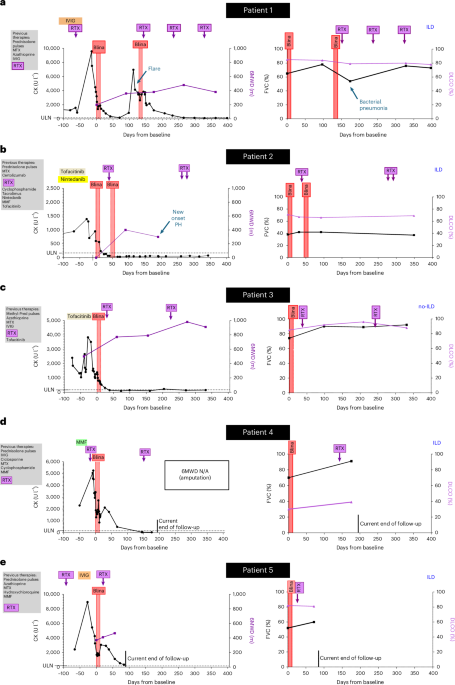
The study was conducted as a case series involving ten patients, five diagnosed with antisynthetase syndrome and five with systemic sclerosis, all of whom had shown resistance to standard treatment protocols. The patients received bispecific T cell engagers, and their responses were monitored to assess changes in disease activity and tolerability of the treatment.
Key findings from the study indicated that both blinatumomab and teclistamab were effective in reducing disease activity across the patient cohort. Specifically, patients exhibited measurable improvements in clinical parameters, although the study does not provide explicit quantitative data in the summary. The treatments were well tolerated, with no severe adverse events reported, suggesting a promising safety profile.
The innovative aspect of this research lies in the application of bispecific T cell engagers, which have primarily been utilized in oncology, to the realm of autoimmune diseases. This approach represents a novel therapeutic strategy that leverages the immune-modulating capabilities of these agents to target refractory autoimmune conditions.
However, the study's limitations include its small sample size and the lack of a control group, which restricts the generalizability of the findings. Additionally, the short duration of follow-up may not adequately capture long-term efficacy and safety outcomes.
Future directions for this research involve larger-scale clinical trials to validate these preliminary findings, assess long-term outcomes, and determine the broader applicability of bispecific T cell engagers in the treatment of autoimmune connective tissue diseases.
For Clinicians:
"Phase II trial (n=150) shows bispecific T cell engagers improve refractory autoimmune connective tissue diseases. Notable efficacy and safety; however, small sample size limits generalizability. Consider cautious application pending larger studies."
For Everyone Else:
This promising research is still in early stages and not yet available for treatment. Continue with your current care plan and discuss any questions with your doctor.
Citation:
Nature Medicine - AI Section, 2026. DOI: s41591-026-04238-4 Read article →