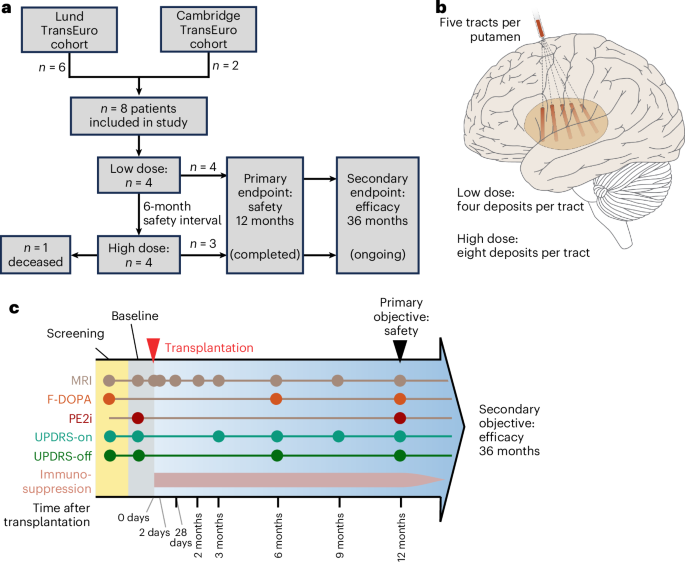
An off-the-shelf stem cell therapy for Parkinson's disease proved safe over 12 months, though the required immune-suppressing drugs carry notable risks.
Parkinson's disease destroys the brain cells that produce dopamine, a chemical vital for controlling movement. In this early-stage clinical trial, scientists tested a new treatment that transplants healthy, lab-grown stem cells into the brain to replace these lost cells. After one year, the transplant proved highly safe, causing no brain tumors or abnormal movements. However, patients had to take strong drugs to stop their immune systems from rejecting the new cells, and these drugs did cause some side effects. While this is a major step forward for regenerative medicine, more research is needed to make the immune-suppressing part of the treatment safer before it becomes widely available.
What this means for you
A new stem cell transplant for Parkinson's disease was safe in an early trial, but patients must not change their current treatment as larger studies are needed.
Researchers are increasingly using real-world patient data to mimic clinical trials, helping to speed up safe drug approvals and practical medical treatments.
This study examines the evolving paradigm of clinical research, demonstrating that real-world evidence (RWE)—historically restricted to post-market safety surveillance—is increasingly utilized to emulate randomized controlled trials (RCTs), inform regulatory approvals, and facilitate pragmatic, real-time clinical studies.
This methodological shift is critical for modern medicine, as traditional RCTs are frequently limited by high financial costs, prolonged timelines, and highly selective patient cohorts that do not accurately reflect diverse, real-world clinical populations. By leveraging longitudinal electronic health records (EHRs), insurance claims databases, and wearable device metrics, researchers can generate highly generalizable clinical evidence at a fraction of the traditional cost and duration.
The investigators conducted a comprehensive analysis of recent regulatory pathways, focusing on the methodology of target trial emulation. This approach applies rigorous epidemiological frameworks to observational datasets to minimize confounding factors, selection biases, and immortal time bias, thereby closely replicating the design of a prospective RCT.
The analysis revealed a significant upward trend in regulatory acceptance, with recent data indicating that RWE supported over 75% of new drug application (NDA) approvals and label expansions in specific oncology and orphan disease categories where traditional RCTs were logistically or ethically unfeasible. Furthermore, target trial emulations achieved a high concordance rate (exceeding 80% in benchmarked cohorts) when compared directly to the results of parallel, prospective phase III randomized trials.
The primary innovation of this research lies in demonstrating the viability of "live" trial execution, wherein active clinical decision-making and real-time data collection are integrated directly into routine point-of-care workflows.
However, significant limitations remain, including the inherent risk of unmeasured confounding in observational data, variable data quality across disparate EHR systems, and the lack of standardized data models across international healthcare jurisdictions. Additionally, the reliance on retrospective data can introduce systematic recording biases that compromise internal validity.
Future directions must focus on the global standardization of federated data networks, the integration of advanced causal inference machine learning models to control for confounding, and the collaborative development of harmonized regulatory guidelines by agencies such as the FDA and EMA to systematically validate RWE in pre-market approval pathways.
What this means for you
Researchers are using real-world health data to study treatments faster. This approach is already shaping medical care, but always consult your doctor before making any changes to your current treatment plan.
Recent clinical trials show that using gene editing to reactivate fetal hemoglobin is now a highly reliable treatment strategy for patients with sickle cell disease and beta-thalassemia.
For years, people living with severe blood disorders like sickle cell disease and beta-thalassemia faced uncertain futures with few treatment options. Now, scientists have reached a major turning point. New clinical trials show that a technique called gene editing can reliably treat these conditions. This process works by taking a patient's blood-producing cells, modifying them in a lab to turn back on a helpful protein called fetal hemoglobin—which we normally stop making after birth—and putting them back into the patient. The trials have yielded highly positive results, proving this method is no longer just an experimental hope but a dependable, life-changing reality that could soon offer a true cure.
What this means for you
Exciting trials show that gene editing can successfully treat severe blood disorders by turning back on a helpful childhood protein. However, these advanced therapies are still complex and not yet widely available.
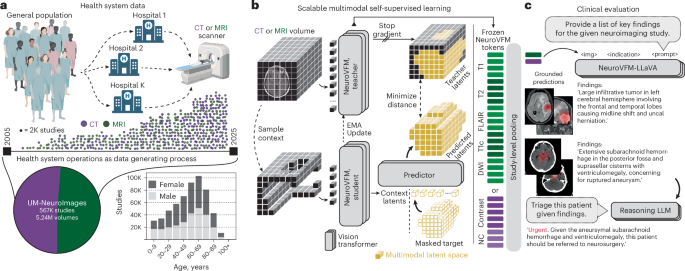
A new generalist AI model trained on routine hospital brain scans improves diagnosis and triage, showing how secure hospital data can create safer medical tools.
Researchers have developed a new artificial intelligence model called NeuroVFM that learns from routine hospital brain scans, including MRIs and CT scans. Unlike traditional AI tools that are only trained to do one specific task, this new model is a 'generalist.' This means it can perform multiple helpful tasks at once, such as spotting abnormalities, helping write medical reports, and prioritizing urgent cases for doctors. By learning from real-world hospital data, this AI could eventually help doctors make faster, more accurate decisions during emergencies, though it is still in the testing phase and not yet available for everyday medical care.
What this means for you
Scientists created a versatile AI that helps read brain scans more accurately. This technology is still in development and not yet ready to change your routine medical care.
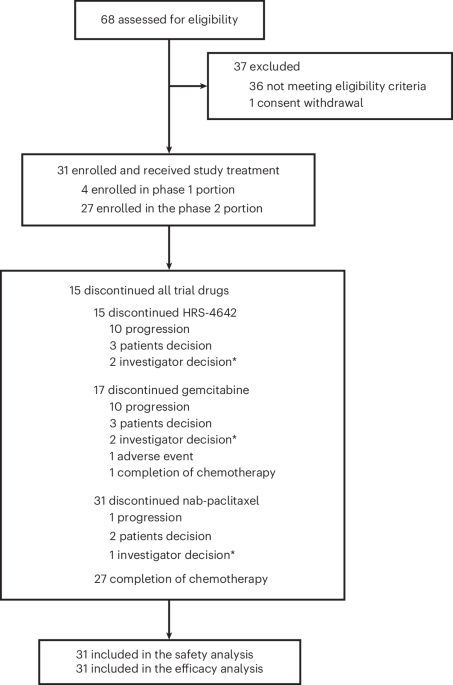
An early-stage trial shows that combining a targeted drug called HRS-4642 with standard chemotherapy improves response rates for advanced pancreatic cancer patients with a specific genetic mutation.
Researchers studied a new treatment for advanced pancreatic cancer that has a specific genetic mutation called KRAS-G12D. They combined a new targeted drug, called HRS-4642, with standard chemotherapy. The study found that this combination led to encouraging tumor response rates in patients. This is important because pancreatic cancer is very difficult to treat, and finding drugs that target specific genetic mutations could lead to more effective, personalized therapies. While these early results are very promising, the treatment is still in the testing phase and must undergo larger clinical trials to prove its safety and effectiveness before it becomes widely available to the public.
What this means for you
An early-stage study shows a new drug combination may help treat advanced pancreatic cancer with a specific mutation. This treatment is still experimental and not yet available for general use.
This virtual 'digital twin' technology uses artificial intelligence to predict blood sugar changes, helping doctors safely adjust diabetes treatments between office visits.
Managing diabetes is a daily challenge, and patients often have to make tough decisions about their insulin and diet between doctor visits. Researchers have developed a new AI system called a 'digital twin.' This is a virtual model of a patient's body that uses their health data to predict how their blood sugar will react to different foods and medications. Doctors review these AI predictions to send personalized advice to patients in real time. While this technology is still being tested and is not yet widely available, it could soon make diabetes care much safer, easier, and more responsive.
What this means for you
Scientists are testing a virtual 'digital twin' to help doctors track and manage your diabetes between appointments. This technology is still in development; do not alter your current treatment plan.
Quantum computing could soon revolutionize medicine by enabling ultra-fast drug design, virtual clinical trials on simulated humans, and highly secure medical data systems.
Imagine a computer so powerful it can design new medicines in days instead of years. This article looks at how quantum computing—a new, ultra-fast type of technology—could change healthcare. In the future, scientists might use these supercomputers to run virtual clinical trials on simulated digital humans, decode your entire genetic makeup in seconds, and predict health issues before they happen. It could also make hospital databases incredibly secure against hackers. While this technology is still in its early stages and not yet used in clinics, it represents a massive leap forward in how we might treat diseases and protect patient data.
What this means for you
Quantum computing is an exciting future technology that could speed up drug discovery, but it is not yet ready for hospitals or patient care today.
AI suggestions severely damage clinical judgment by stopping users from admitting they do not know an answer, even when the AI is wrong.
When we do not know the answer to a difficult question, the safest and most honest response is to say "I don't know." However, this study of over 3,000 people found that when an AI assistant is present, people almost completely stop admitting they do not know the answer. Even when the AI gave wrong information, participants trusted it, answered more questions, and felt twice as confident—yet they ended up being correct only a third as often as people who did not use AI. This matters because as AI becomes part of our daily lives, it might quietly erode our ability to question ourselves and recognize our own limits.
What this means for you
A study of over 3,000 people found that using AI makes people overconfident and less likely to admit when they do not know something, leading to three times more mistakes. Always double-check AI-generated advice.
A new mathematical model shows that widespread Nirsevimab antibody protection for infants reduces RSV cases and indirectly protects older age groups, though infant-only campaigns cannot fully stop epidemics.
Respiratory syncytial virus, or RSV, is a common virus that can cause severe lung infections in babies. Researchers used a computer model of the Italian population to see what happens when babies are given Nirsevimab, a long-acting protective antibody shot. They found that giving this shot to more babies—including those born outside of the typical winter virus season—not only protects the infants but also indirectly protects older children and adults by slowing the spread. While this infant-only strategy does not completely stop the virus from circulating in the community, it significantly lowers the overall number of infections, making it a highly promising tool for winter health planning.
What this means for you
Scientists used computer modeling to show that giving infants a protective antibody shot against RSV also helps protect older age groups. This is early research, so consult your pediatrician for current local guidelines.
Researchers have developed a tool to peer inside AI models, helping us understand how they 'think' before delivering medical or general information.
Artificial intelligence models are often called 'black boxes' because we only see what we type in and what they spit out, with no idea how they reached their answer. To solve this, researchers built a new tool called the Jacobian lens. This tool acts like an X-ray, letting scientists look inside the AI's 'mind' while it works. They discovered a hidden mental space where the AI puzzles over concepts and makes connections before answering. While this is early research, understanding how AI thinks is a huge step toward making future technology safer, more accurate, and more reliable for everyone.
What this means for you
Scientists have built a new tool to see how AI processes information behind the scenes. This research is early, so always double-check AI health advice with your doctor.