
Mednosis LogoMednosis
Jun 3, 2026

Clinical Innovation: Week of June 03, 2026

7 research items

Clinical Innovation: Week of June 03, 2026
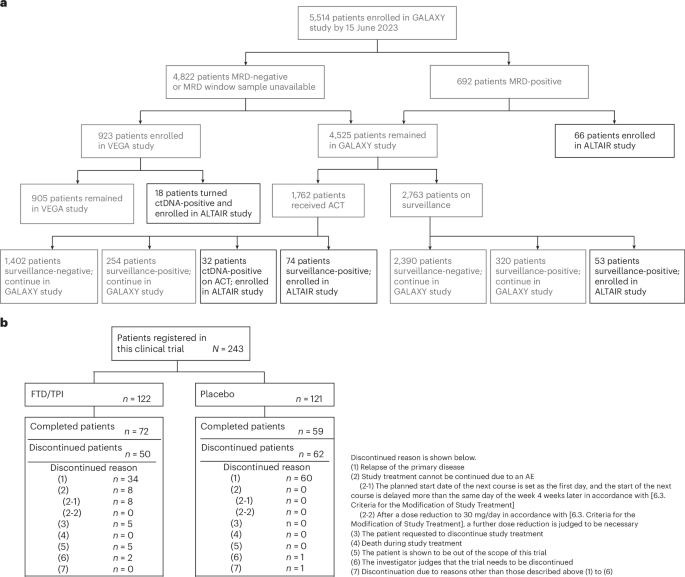
Post-adjuvant chemotherapy in ctDNA-positive patients with resected colorectal cancer: a randomized phase 3 trial
Nature Medicine - AI SectionPromising2 min read

DNA Blood Tests Fail to Guide Successful Colon Cancer Treatment

Key Takeaway:

For patients with resected colorectal cancer, using a specific chemotherapy drug after detecting tumor DNA in the blood during monitoring did not successfully delay cancer recurrence.

When patients have surgery for colon cancer, doctors monitor their blood for tiny fragments of tumor DNA, known as ctDNA, which can signal that the cancer is trying to return. In this study, researchers wanted to see if giving a chemotherapy pill called trifluridine/tipiracil to patients with these positive blood tests would help them stay cancer-free longer. Surprisingly, the study found that this chemotherapy did not delay the return of the cancer compared to a dummy pill, or placebo. For regular people, this means that while highly sensitive blood tests can spot early warning signs of cancer, doctors still need to find the right treatments to actually stop the disease at this early stage.

What this means for you

This study shows that a specific chemotherapy pill did not stop colon cancer from returning, even when blood tests caught early signs of tumor DNA. Patients should not change their current treatment plans.

Citation:

Nature Medicine - AI Section, 2026. DOI: s41591-026-04428-0 Read article →

Healthcare IT NewsPromising2 min read

How background AI is putting doctors' focus back on patients

Key Takeaway:

Implementing ambient AI in exam rooms aims to reduce the electronic documentation burden, allowing doctors to focus directly on patients rather than computer screens during visits.

For years, a major frustration in healthcare has been doctors spending more time typing on computers than looking at their patients. During appointments, doctors must constantly balance talking to patients with a massive amount of electronic paperwork, like writing referral letters and updating digital health records. To solve this, Beth Israel Lahey Health is introducing ambient artificial intelligence—a system that listens in the background to automatically handle clinical notes. By taking over the typing, this technology aims to reduce doctor burnout and, most importantly, allow your physician to look you in the eye and focus entirely on your care during your visit.

What this means for you

Doctors are testing new background AI technology to handle computer paperwork during visits, allowing them to focus entirely on you. This technology is currently being adopted to improve your face-to-face care.

Citation:

Healthcare IT News, 2026. Read article →

Guideline Update
Translating ‘food is medicine’ from concept to reality
Nature Medicine - AI SectionPromising2 min read

Can Prescribing Healthy Meals Lower Your Medical Bills?

Key Takeaway:

Medically tailored meals show promise in lowering healthcare costs and hospital use, but larger clinical studies are needed before this approach can be widely integrated into standard medical practice.

The ancient idea that 'food is medicine' is gaining modern scientific backing. Researchers are studying 'medically tailored meals'—healthy dishes customized for patients with specific medical conditions. Early evidence shows that providing these specialized meals can help keep patients healthier, leading to fewer hospital visits and lower overall healthcare costs. However, because most studies so far have been small, researchers need to conduct much larger trials to prove exactly how well these meal programs work. If successful, this research could pave the way for insurance companies and health systems to officially cover healthy food as a standard part of medical treatment.

What this means for you

Eating medically tailored meals may help lower healthcare costs, but larger studies are still needed. Please consult your doctor before making any major changes to your prescribed medical or dietary plans.

Citation:

Nature Medicine - AI Section, 2026. DOI: s41591-026-04420-8 Read article →

Google News - AI in HealthcarePromising2 min read

New Safety Guides Launched to Help Hospitals Use AI Responsibly

Key Takeaway:

The Coalition for Health AI has launched new governance playbooks to help healthcare organizations safely and responsibly adopt artificial intelligence tools starting now.

As artificial intelligence quickly enters the medical field, there is a growing concern about how to use these powerful tools safely. To address this, an organization called the Coalition for Health AI has released new step-by-step guides, called playbooks, for hospitals and clinics. These guides help healthcare leaders carefully check AI tools before using them on patients, set up watchdog groups inside hospitals, and make sure the technology treats all patients fairly. For the average person, this means the medical community is actively working to ensure that any AI used in your diagnosis or treatment has passed strict safety checks.

What this means for you

A major health coalition has released new safety guides to help hospitals use artificial intelligence responsibly. This aims to protect your data and ensure fair, safe care as AI tools roll out.

Citation:

Google News - AI in Healthcare, 2026. Read article →

Guideline Update
ArXiv - AI in Healthcare (cs.AI + q-bio)Promising3 min read

How Casual AI Chats Quietly Replace Real Human Connections

Key Takeaway:

Routine, brief daily interactions with general-purpose AI can silently shift human preferences away from real-world support networks toward digital alternatives within just one month.

We often think people only bond with AI if they are lonely and looking for a virtual companion. However, new research shows that emotional attachment often happens by accident during everyday tasks on standard AI platforms. In a study conducted with OpenAI, people who chatted with an AI about personal topics for just five minutes a day over 28 days experienced a shift in their social habits. Their preference for seeking support from other humans dropped by 10.3%, while their preference for AI support rose by 11.6%. This matters because routine technology use can quietly steer us away from real-world relationships, meaning future safety policies must look beyond 'companion apps' to protect human connection.

What this means for you

Interacting with AI for just five minutes a day can quietly lower your desire to seek support from family and friends. Be mindful of relying on technology instead of human relationships for emotional comfort.

Citation:

ArXiv, 2026. arXiv: 2606.04150 Read article →

Guideline Update
ArXiv - Quantitative BiologyExploratory3 min read

A New Mathematical Theory Explains How Minds Think and Remember

Key Takeaway:

This new mathematical theory explains how biological and artificial minds organize memory and reasoning, which could eventually help researchers design better diagnostic tools for cognitive decline.

Researchers have developed a new mathematical theory, called cognitive field theory, to explain how both human brains and artificial intelligence learn and remember. Currently, scientists use different rules to describe computer learning versus human thinking. This new model unifies them by showing that memory and reasoning are created by slow-moving, organized patterns of activity. These patterns help the system hold onto information for long periods without forgetting. While this is highly technical math, understanding these basic rules of the mind could eventually help doctors better understand memory loss diseases or help engineers build more human-like medical AI.

What this means for you

Scientists have created a new mathematical theory to explain how the brain processes memory and learning. This is early research and does not change current medical care.

Citation:

ArXiv, 2026. arXiv: 2601.10221 Read article →

Guideline Update
Rehumanizing global health care with agentic AI
MIT Technology Review - AIExploratory2 min read

Can Smart AI Help Fix the Global Doctor Shortage?

Key Takeaway:

Agentic AI could help relieve severe global healthcare strain and clinician burnout by automating administrative tasks, though practical clinical timelines remain undefined.

The world's healthcare systems are under massive pressure. Years of underfunding and difficulties in hiring new staff have collided with a growing, aging population that needs more care than ever. This has led to fragmented medical services and extremely high rates of stress and burnout among doctors and nurses. This report looks at how 'agentic AI'—smart computer systems that can perform tasks independently—might help. By taking over time-consuming paperwork and administrative chores, these AI tools could free up medical professionals, allowing them to focus on what they do best: caring for patients.

What this means for you

Global healthcare is facing major staffing shortages and burnout. While new AI technologies are being explored to help doctors spend more time with patients, these solutions are still in early development.

Citation:

MIT Technology Review - AI, 2026. Read article →

New to reading medical AI research? Learn how to interpret these studies →