
Mednosis LogoMednosis
Aug 21, 2026

Clinical Innovation: Week of August 21, 2026

8 research items

Clinical Innovation: Week of August 21, 2026
Google News - AI in HealthcareExploratory3 min read

Hospitals Face Legal Battles in the Race to Adopt AI

Key Takeaway:

Intense competition among hospitals to quickly implement healthcare artificial intelligence has sparked major legal disputes over technology deployment, underscoring the urgent need for sound governance.

Hospitals around the country are racing to adopt artificial intelligence to improve care and modernize medicine. However, this fast-paced competition is creating serious friction between major medical institutions, leading to legal disputes over technology and deployment strategies. Because organizations want to lead the market, the pressure to be first can sometimes clash with standard operational practices. For regular patients, this highlights that while smart computer tools are coming to healthcare, health systems are still sorting out the legal and organizational rules governing how these technologies are introduced.

What this means for you

Hospitals are competing rapidly to use artificial intelligence, which has led to legal disagreements. Patients should know that standard clinical care remains guided by existing, proven safety procedures.

Citation:

Google News - AI in Healthcare, 2026. Read article →

Guideline Update
ArXiv - AI in Healthcare (cs.AI + q-bio)Exploratory3 min read

Can Math Explain How Machines Might Experience the World?

Key Takeaway:

Researchers have proposed a mathematical framework to conceptualize artificial consciousness, though it remains a purely theoretical model with no current clinical applications.

Scientists are exploring the deep question of what it would mean for an artificial intelligence to have a subjective experience of its environment. In this theoretical paper, researchers used an advanced branch of mathematics called category theory alongside machine learning algorithms known as Q-networks to create a model for artificial consciousness. Instead of treating intelligence as just processing data, their model focuses on how an agent continuously interacts with and reacts to the world around it. While this research is strictly theoretical and does not offer any immediate medical tools or treatments, it provides a foundational step toward understanding how future intelligent systems might perceive and interact with complex surroundings.

What this means for you

Scientists have developed a new mathematical theory exploring how artificial intelligence might experience interactions with the world. This is early basic research and does not impact medical care or treatments.

Citation:

ArXiv, 2026. arXiv: 2608.20420 Read article →

Safety Alert
The Future of Emergency Medicine: 6 Technologies That Make Patients The Point-of-Care
The Medical FuturistExploratory3 min read

How New Technologies Could Bring Emergency Care Directly to You

Key Takeaway:

Emerging point-of-care technologies aim to bring emergency medical treatment directly to patients immediately following severe accidents, potentially saving critical minutes when standard care is delayed.

In severe emergencies like car accidents, fires, or natural disasters, every second matters. Waiting for treatment can lead to dangerous complications or loss of life. This report looks at six new technologies designed to bring emergency care directly to the patient, turning the scene of an accident into an immediate site of treatment. Instead of losing valuable time waiting to reach a hospital, these tools aim to help people get the critical care they need right away. While these ideas are still evolving, they represent an exciting step toward faster, life-saving emergency responses for everyday people facing unexpected crises.

What this means for you

New technologies are being explored to deliver emergency treatment directly at the scene of accidents. These concepts are still developing, so continue relying on standard emergency services (like calling 911).

Citation:

The Medical Futurist, 2026. Read article →

ArXiv - Quantitative BiologyExploratory2 min read

How the Earliest Cells and Genes Learned to Cooperate

Key Takeaway:

Mathematical models suggest early life formed through cooperation between primitive cell compartments and genetic elements, with random division driving early evolutionary survival.

Scientists used mathematical modeling to explore how the earliest living cells might have formed billions of years ago. They proposed that primitive bubble-like compartments containing simple chemical networks originally took in self-copying genetic elements that acted purely for themselves. Over time, the compartments and genetic material formed a cooperative team. The models show that for these new life forms to survive and take over, their copying needed to link with cell division. Interestingly, uneven, random cell splitting was actually better for survival in the beginning than neat, even splitting. This research helps map how simple chemical mixtures eventually transformed into complex living cells.

What this means for you

This is fundamental theoretical research exploring how the earliest forms of life first evolved billions of years ago. It has no direct impact on current healthcare or medical treatments.

Citation:

ArXiv, 2026. arXiv: 2608.22348 Read article →

Google News - AI in HealthcarePromising2 min read

FDA Selects First Mental Health AI Company for Review Program

Key Takeaway:

Limbic has entered the FDA's TEMPO program, representing a significant regulatory milestone for integrating artificial intelligence tools into mental health services over the coming years.

Limbic has become the first AI-focused mental healthcare company chosen to take part in the FDA's TEMPO program. The Food and Drug Administration uses specialized programs like this to closely evaluate innovative technologies, ensuring they are both safe and helpful for patients throughout their development. While this initial announcement does not share specific clinical trial data or immediate changes to patient care, it highlights a major step forward in how government regulators review digital mental health tools. For the public, it shows that artificial intelligence in mental healthcare is moving into structured oversight frameworks to verify its quality before broader use.

What this means for you

A mental health AI company has joined an FDA program to review its technology. Patients should continue standard care while regulatory evaluations and clinical testing proceed.

Citation:

Google News - AI in Healthcare, 2026. Read article →
Putting epigenetic aging clocks on trial
Nature Medicine - AI SectionExploratory2 min read

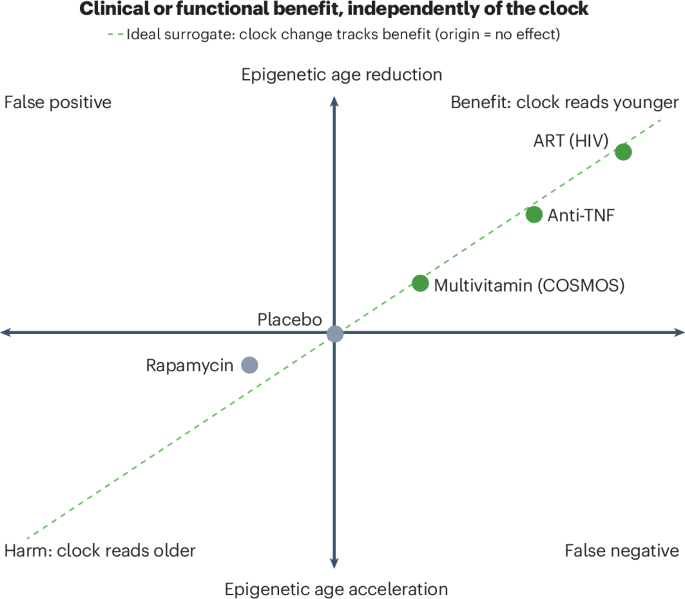
Can Biological Age Clocks Truly Measure Real Anti-Aging Treatments?

Key Takeaway:

Scientists conducted the first systematic trial to verify whether DNA methylation aging clocks accurately reflect true medical anti-aging benefits before using them in clinical trials.

Our bodies change over time, and scientists often look at chemical tags on our DNA—known as epigenetic clocks—to guess our biological age. However, doctors have not been sure if these clocks truly reflect real health improvements. This study provides the first systematic test to see if biological age clocks behave the way medical tools should. A good medical test needs to show positive changes when a treatment actually helps someone, and stay steady when a treatment does nothing. Verifying how these clocks work is a major step toward developing reliable ways to test future healthy-aging treatments.

Citation:

Nature Medicine - AI Section, 2026. DOI: s41591-026-04524-1 Read article →

What Flock’s defenders are missing
MIT Technology Review - AIExploratory3 min read

Police-Tech Giant Flock Updates Its Massive Vehicle-Tracking Network

Key Takeaway:

Surveillance tech company Flock is updating its 120,000 license plate reader network to curb system misuse, highlighting ongoing debates around algorithmic monitoring and data privacy.

Flock, a major technology company that works with police departments, operates a network of around 120,000 automatic license plate readers across the United States. These automated cameras capture and track vehicle movements. The company recently announced updates to its platform designed to stop misuse and address growing privacy concerns. Understanding how large-scale automated camera systems are managed matters to everyday citizens because automated tracking touches on basic privacy rights. As computer vision tools become common in daily life, establishing clear limits and oversight is essential to keep technological systems accountable and prevent potential abuses.

What this means for you

A major police-technology company is changing how it runs its 120,000 vehicle-tracking cameras to prevent misuse, emphasizing the need for public privacy safeguards as AI monitoring expands.

Citation:

MIT Technology Review - AI, 2026. Read article →

Safety Alert
Gaining Leadership Backing for Your Innovations
IEEE Spectrum - BiomedicalExploratory3 min read

How to Get Leaders to Back Your Big New Ideas

Key Takeaway:

Advancing workplace innovations requires building a multi-level triad consisting of a technical expert, a process navigator, and an executive sponsor to secure lasting organizational support.

Having a great idea at work is rarely enough to turn it into a real product. Often, good concepts get lost because they fall outside regular job duties. This article explains that successful innovation requires teamwork across three key roles: a technical expert who understands the product, a process guide who knows company politics and rules, and a leader with the authority to provide funding and remove obstacles. Famous projects like 3M's Post-it Notes and Amazon's hardware labs succeeded because they had support from multiple levels of management. To get an idea off the ground, workers must build small coalitions rather than trying to push changes alone.

What this means for you

This article shares career and management advice for turning ideas into real-world products. It does not evaluate medical treatments, clinical procedures, or patient healthcare decisions.

Citation:

IEEE Spectrum - Biomedical, 2026. Read article →

New to reading medical AI research? Learn how to interpret these studies →